
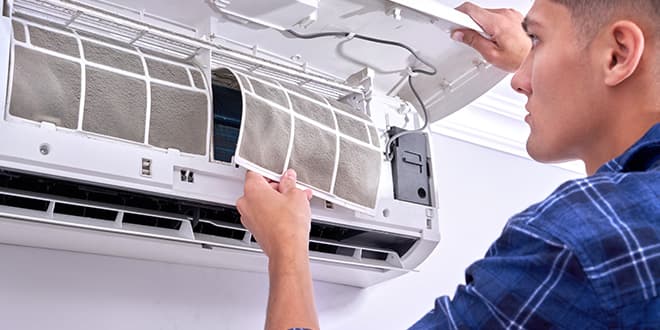
If you’re dealing with after replacing air filter AC not cooling properly, you’re not alone. Homeowners commonly notice this issue right after changing their air filter, and it can feel confusing — or even alarming — when a simple maintenance task seems to make things worse.
The good news is that this is very common after changing an air filter and is usually caused by airflow issues or installation mistakes, not a serious system failure. In most cases, the problem is simple, safe to check, and easy to fix without tools or technical experience.
This guide explains why it happens, what you can safely look at in under 10 minutes, and how to know whether your AC just needs a small adjustment or professional help.
Why an AC May Stop Cooling After Replacing the Air Filter
Your air filter plays a much bigger role in cooling than most people realize.
It doesn’t just clean the air — it controls how much air can flow through your system.
When airflow changes, it affects:
- how much warm air reaches the evaporator coil
- how efficiently heat is removed
- how cold air is delivered back into your home
If the new filter restricts airflow too much or is installed incorrectly, the evaporator coil can’t absorb heat properly. That can cause weak cooling, warm air from vents, or even ice forming on the coil.
HVAC technicians often explain that modern systems are carefully balanced for airflow. Even a small change in filter size, thickness, or resistance can disrupt that balance.
Is This Normal or a Sign of a Problem?
In many homes, a short cooling delay after changing a filter is normal. But not all symptoms should be ignored.
Normal, temporary behavior
- Cooling improves within 30–60 minutes
- Airflow feels normal or stronger than before
- Vent air gradually gets colder
- No strange noises or ice buildup
This usually means the system is stabilizing.
Signs of a real problem
- AC blowing warm air after filter replacement
- Very weak airflow from vents
- Ice forming on refrigerant lines or indoor unit
- System runs constantly but never cools
- AC works but not cooling after filter change
These red flags mean something about the new filter or airflow setup isn’t right.
Most Common Reasons This Happens
Wrong Filter Size or Thickness
If the filter doesn’t match your system’s required dimensions, it can restrict airflow or allow air to bypass the filter.
Problems include:
- filter too thick for the slot
- filter too narrow or short
- air gaps around edges
This is a very common cause of AC not cooling after filter change.
Filter Installed Backward
Most filters have a small arrow showing airflow direction.
If it’s reversed:
- the filter loads with dust unevenly
- airflow resistance increases
- cooling efficiency drops
This is one of the most frequent mistakes HVAC technicians see.
Too Restrictive (High-MERV) Filter
High-MERV filters trap more particles — but they also block more air.
In older or smaller systems, a very dense filter can cause:
- airflow decreased after changing air filter
- weak cooling
- frozen evaporator coil
This often explains wrong air filter causing AC problems.
Filter Not Seated Properly
If the filter isn’t fully pushed into place or sits crooked:
- air leaks around it
- airflow becomes turbulent
- cooling performance drops
This can lead to air conditioner not cooling after replacing filter even if the filter itself is correct.
Dirty Evaporator Coil Revealed by New Filter
In some homes, a very dirty old filter was blocking airflow so badly that the coil never got cold enough to freeze.
When a clean filter improves airflow:
- the coil suddenly gets colder
- ice forms
- cooling stops
This makes it seem like the new filter caused the problem — but it only revealed it.
(Related: After cleaning furnace blower airflow decreased)
What You Can Check Yourself (Safe Steps)
These steps are safe and take about 10 minutes.
1) Remove the filter and check the arrow
- Look for the airflow arrow
- It should point toward the blower / furnace
- Reinstall correctly if backward
2) Verify size and thickness
- Compare old and new filters
- Confirm exact dimensions
- Check that thickness matches system requirements
3) Inspect how the filter sits
- Fully inserted
- No bending or bowing
- No gaps around edges
4) Temporarily run the AC without the filter (10–15 minutes)
- Turn system on
- Let it run briefly
- Check airflow and cooling
⚠️ Important:
Do not leave the system without a filter longer than 10–15 minutes.
Do not operate it like this long-term.
If cooling improves without the filter, the filter is the problem.
5) Check airflow at vents
- Is airflow weaker than before?
- Uneven between rooms?
This helps confirm airflow restriction.
What NOT to Do
- Don’t install the densest filter “just to be safe”
- Don’t ignore weak airflow
- Don’t keep running the system if ice is forming
- Don’t open system panels
- Don’t operate long-term without a filter
How Long Should It Take for Cooling to Return?
Immediately
→ likely a filter size, direction, or restriction problem
Within 30–60 minutes
→ normal stabilization
Doesn’t return after an hour
→ airflow or system issue needs attention
When to Call an HVAC Technician
Call for help if:
- AC not cooling for 24+ hours
- Ice keeps forming
- Loud or unusual noises
- Breaker trips
- Cooling gets worse over time
In many homes, technicians find simple airflow or coil issues behind these symptoms.
(Related: After installing smart thermostat rooms heat unevenly)
How to Prevent This in the Future
- Use the correct filter size
- Choose moderate MERV ratings
- Always check airflow arrow
- Replace filters regularly
- Keep evaporator coil clean
In most cases, consistent maintenance prevents repeat problems.
FAQ
Is it normal for AC not to cool after replacing the filter?
Yes. In many homes this happens briefly and resolves once airflow stabilizes.
Can a wrong air filter cause AC not to cool?
Yes. Wrong size, thickness, or MERV rating can restrict airflow enough to stop cooling.
Should I run AC without a filter to test it?
Yes — but only for 10–15 minutes. Never long-term.
What MERV rating is best for my AC?
Most systems work best with low to moderate MERV ratings. Very high ratings often reduce airflow.
Why did my AC work fine before changing the filter?
The old filter may have masked an airflow or coil issue. A clean filter can reveal it.
Final Takeaway
If you’re dealing with after replacing air filter AC not cooling properly, don’t panic.
In most cases, it’s caused by airflow restriction, installation mistakes, or filter selection — not a serious breakdown.
Check:
- filter direction
- size and thickness
- seating
- airflow strength
Most cooling problems after a filter change are simple, fixable, and not dangerous to your system.
If cooling doesn’t return within a few hours or ice appears, that’s when it’s time to call a technician.